
Study desk organization accessories for clutter control
Study desk organization accessories are tools used to manage clutter and keep study materials accessible through sorting, grouping, and controlled access. Study desk organization accessories define a category of organization tools that help organize stationery, papers, trays, and holders within a study desk workspace. This page frames their role in clutter control and material visibility rather than decoration or product collecting. Organization in this context focuses on sorting and access control rather than decoration.
When a study desk is used for different subjects, note-taking styles, or supply needs, organization accessories can help keep frequently used study materials within reach while reducing visible clutter. Desk organizers, trays, and holders may serve different purposes depending on the workspace footprint and how supplies are grouped. For broader context on related workspace components, see the study desk setup accessories hub. Organizer suitability depends on desk size, supply volume, and study habits.
Clutter can make stationery, papers, and other study materials harder to locate and access during study sessions. Study desk organization accessories address this challenge by creating clearer sorting, grouping, visibility, and reach within the workspace. The specific organization approach may vary by available space and supply volume. This broad clutter-control context leads into the definition of study desk organization accessories and their role within a study workspace.
What study desk organization accessories include
Study desk organization accessories are items that sort, group, or position study supplies for easier access during study activities. Study desk organization accessories include tools that organize stationery, papers, notebooks, and similar materials within a workspace. Their main function is sorting and access.
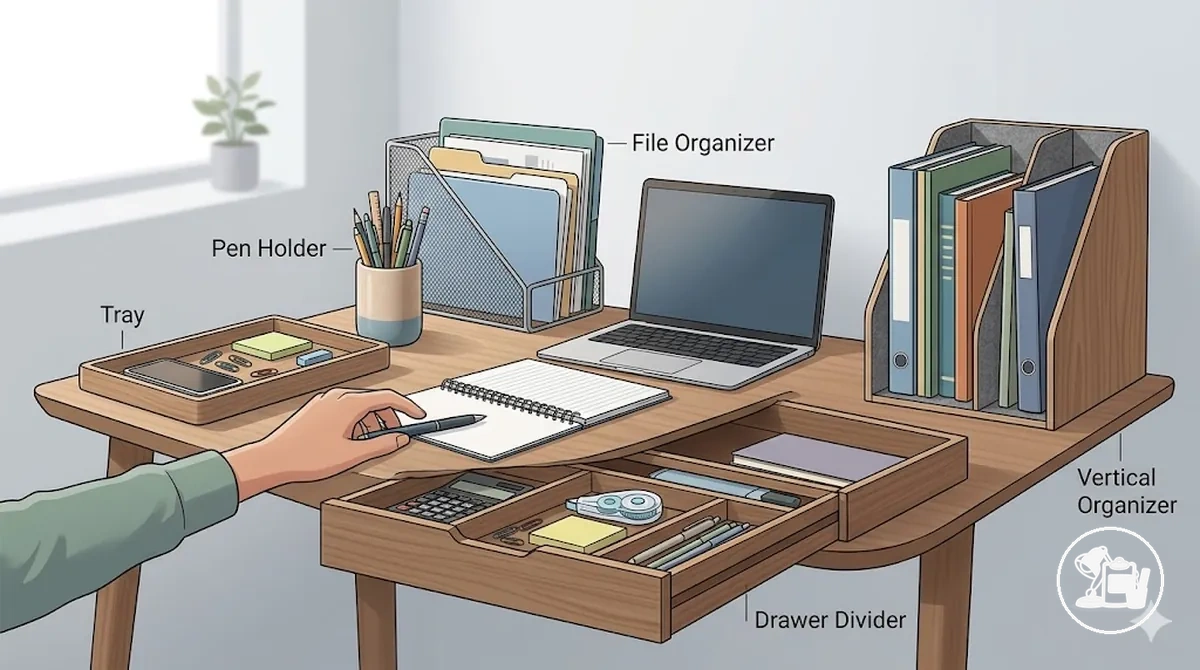
Study desk organization accessories include trays, holders, drawer dividers, file organizers, and vertical organizers because each type helps group or position supplies according to use. Trays can keep related stationery together, holders can keep writing tools accessible, drawer dividers can create separation between supplies, and file organizers can improve visibility and reach for papers or notebooks. Vertical organizers help position materials upright to use available workspace more efficiently. What study desk organization accessories include is best understood by grouping these examples according to organizing function rather than product type.
A common misconception is that every organization accessory is primarily a storage item. In practice, study desk organization accessories are defined by how they sort, group, and position supplies for access. The page on essential accessory functions defines related accessory roles, while overlap with storage accessories may occur when an item supports both organization and storage depending on its function and use.
Desk clutter patterns organization accessories should solve
Desk clutter patterns highlight areas where study materials are difficult to access or organize effectively. Recognizing these patterns allows one to select appropriate organization accessories that reduce visible clutter and improve access to essential supplies. Clutter patterns should guide organizer choice to address specific desk issues.
Frequent scenarios include scattered stationery across the desk surface, loose papers overlapping or misplaced, mixed drawers lacking separation, overfilled desktops limiting surface space, and hard-to-reach daily supplies. These situations reveal whether the clutter arises from too many visible items or from poor separation of materials.
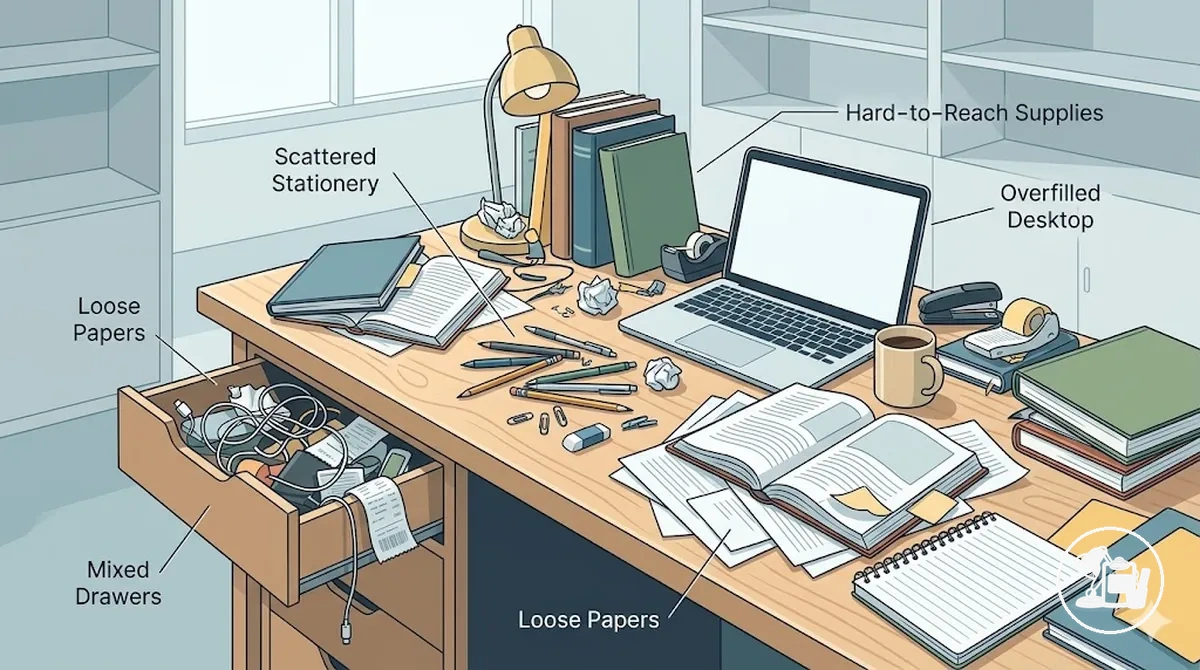
Desk clutter patterns organization accessories should solve can be summarized as follows:
- Scattered stationery: caused by ungrouped items; trays and holders help consolidate and group supplies.
- Loose papers: caused by lack of separation; file organizers and letter trays improve visibility and reach.
- Mixed drawers: caused by unsegmented compartments; drawer dividers or compartments separate items efficiently.
- Overfilled desktop: caused by excessive items in limited space; vertical organizers or tiered trays manage footprint and maintain access.
- Hard-to-reach supplies: caused by poor positioning; rearrangement within organizers enhances accessibility.
While organization accessories can address many clutter problems, some setups may only relocate items without reducing visible clutter. It is important to assess each desk pattern carefully before selecting accessories, avoiding assumptions that all organizers automatically improve access or reduce clutter.
Core accessory types for organizing study materials
Accessory types for organizing study materials are organizer categories distinguished by how they group, separate, hold, or elevate study items. Different accessory types use attributes such as compartment design, placement style, capacity, and access level to address different organization needs. Their role is not identical because each type supports a different item group and organization effect. These accessory types can be grouped according to organization function.
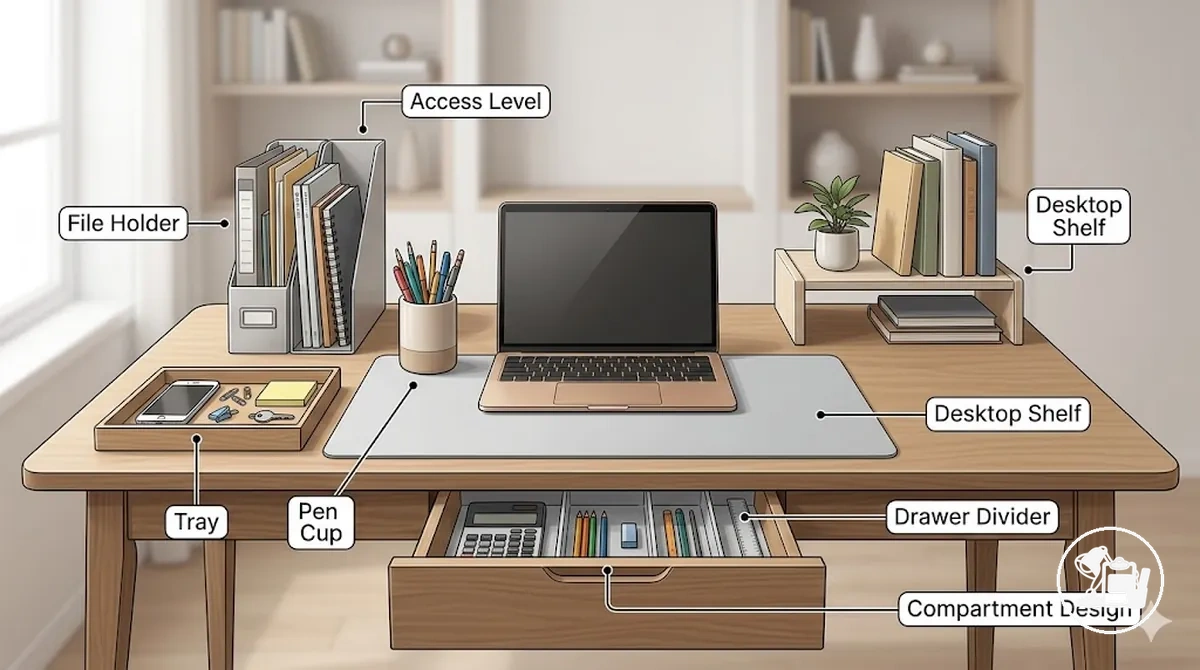
Accessory type selection depends on the study materials being organized and the clutter problem being addressed. The table below highlights how trays, pen cups, drawer dividers, file holders, and desktop shelves differ by function and attribute. Each organizer family connects an attribute to an outcome, creating an EAV relationship between accessory type, useful attribute, and organization effect.
| Accessory type | Organizes best | Useful attribute | Clutter problem solved |
|---|---|---|---|
| Trays | Small supplies | Open placement style | Items spread across the desk surface |
| Pen cups | Writing tools | Vertical access level | Frequently used tools lacking reach |
| Drawer dividers | Mixed supplies | Compartment design | Poor separation inside drawers |
| File holders | Papers and notebooks | Vertical visibility | Stacked or misplaced documents |
| Desktop shelves | Study materials with varying use frequency | Elevated storage level | Limited surface access |
When a desk contains both writing tools and paper materials, different accessory types may be combined to support separate organization goals. For example, file holders organize papers differently from pen cups because they prioritize visibility rather than immediate tool access. These attribute-based distinctions provide the foundation for the following H3 accessory groups.
Trays, pen cups, and small-supply organizers
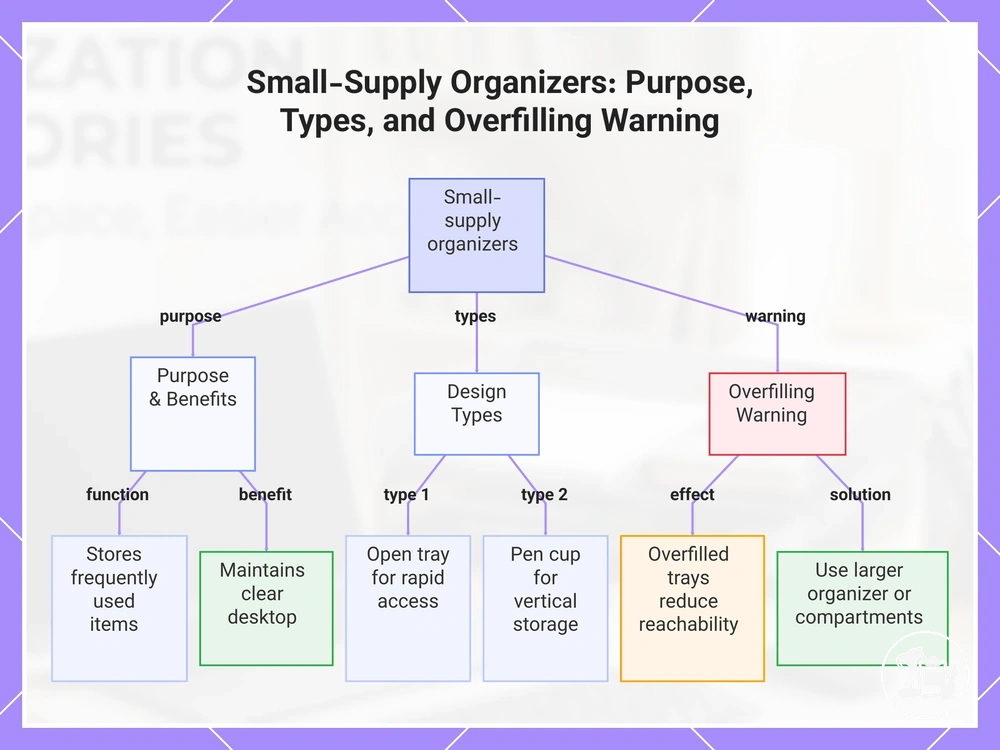
Trays, pen cups, and small-supply organizers hold frequently used study items such as pens, pencils, erasers, and sticky notes, keeping them visible and easily reachable. Open trays allow rapid access to small items, while pen cups provide vertical containment for writing tools, helping maintain clear desktop space and minimizing scattered supplies .
For instance, a small desk might pair a tray for sticky notes with a pen cup for pencils and pens. If trays become overfilled, their openness can reduce reachability, suggesting that additional compartments or a larger organizer may be needed to maintain effective access and desktop organization .
This chart shows the functions, design types, and overfilling warning for small-supply organizers used in study spaces.
Drawer dividers and hidden compartment organizers
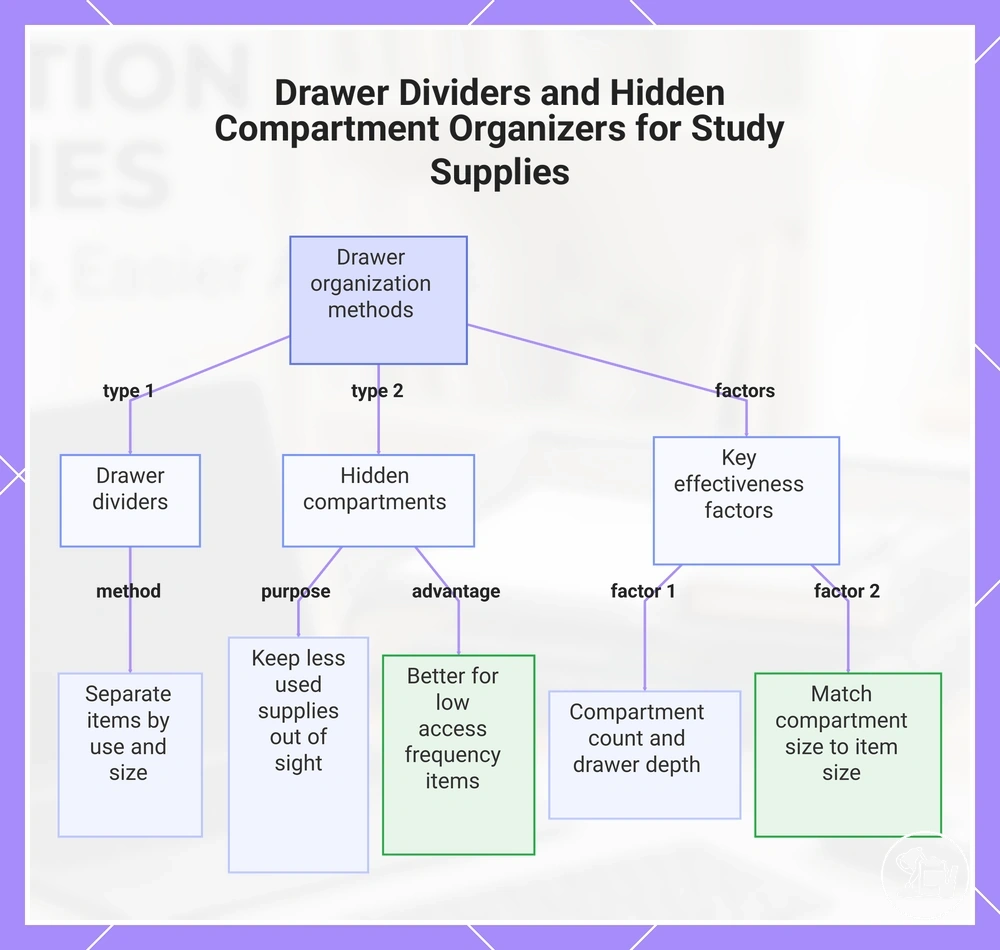
Drawer dividers and hidden compartment organizers separate supplies inside drawers according to item size, access frequency, and available drawer space. Drawer dividers create compartments that organize study tools into distinct sections, while hidden compartments keep less frequently used supplies out of sight. Compartment count and drawer depth influence how effectively hidden separation is maintained.
When study supplies are stored below the desktop, drawer dividers can separate items based on use and size, helping maintain clearer organization within the drawer. Hidden compartments may be more useful for supplies with lower access frequency because visibility is less important than separation. Matching compartment size to item size can improve fit and usability within the available drawer depth.
This chart explains the two main drawer organization methods and the key factors for effective separation of study supplies.
File holders, letter trays, and paper organizers
File holders, letter trays, and paper organizers hold notebooks, worksheets, loose sheets, and active documents in organized positions that improve visibility and access. File holders often display papers vertically, while letter trays separate or stack documents horizontally according to capacity and use. Orientation and visibility influence accessibility, making active documents such as current study worksheets a primary use case.
When papers are referenced frequently during study sessions, visibility often matters more than long-term separation. A vertical file holder may make notebooks or active documents easier to locate, while a letter tray can separate loose sheets into distinct groups. Paper organizers support accessibility when capacity matches paper volume, and visibility may decrease if documents become heavily stacked.
Desktop shelves and vertical organizers
Desktop shelves and vertical organizers elevate study materials above the desk surface, helping free surface space while maintaining visibility. Vertical organizers use height to reduce surface crowding, while desktop shelves hold and display items within reach. Shelf height, footprint, stability, and reach influence whether a vertical arrangement remains suitable for a particular desk size, supporting surface-space relief through vertical use.
On a compact desk, a raised organizer may free more surface space because it uses height rather than additional width. Desktop shelves and vertical organizers can improve organization when shelf height allows comfortable reach and when footprint and stability remain appropriate for the available desk area. Suitability often depends on maintaining stability while keeping frequently used items within reach.
Organization accessories versus storage, cable, and cleaning accessories
Organization accessories are primarily used to sort items, improve access, and reduce visible clutter on a study desk. They are distinct from storage accessories, cable management accessories, and cleaning accessories, each of which serves a different primary job and impacts clutter differently. This section clarifies the boundaries between these accessory types to highlight their specific roles.
A common misconception is that all desk accessories serve the same function. While some storage tools may incidentally support sorting, and some cable management accessories may reduce visual clutter, organization accessories remain focused on immediate access and material arrangement without expanding into full storage or wire routing functions. Overlap is possible, but the scope of organization accessories is limited to sorting and access control.
In practical scenarios, organization accessories handle stationery, documents, and frequently used study items, while storage accessories contain less frequently used items, and cable management accessories route wires to reduce visual clutter. Cleaning accessories address dust and surface condition without replacing organization functions.
| Accessory group | Primary job | Best-fit items | Clutter outcome | Boundary note |
|---|---|---|---|---|
| Organization accessories | Sort and access | Stationery, notebooks, papers | Reduces visible clutter, improves reach | Focus on grouping and immediate access |
| Storage accessories | Store and contain | Boxes, bins, drawers | Manages surplus items; may support secondary sorting | Primary focus is capacity, not immediate access |
| Cable management accessories | Route and secure | Cords, chargers, wires | Reduces wire clutter and tangling | Targeted at wires; incidental sorting of small items possible |
| Cleaning accessories | Maintain surface condition | Dusters, wipes, brushes | Reduces dust and surface clutter | Focus is maintenance, not material organization |
Choosing organizers by item frequency and desk size
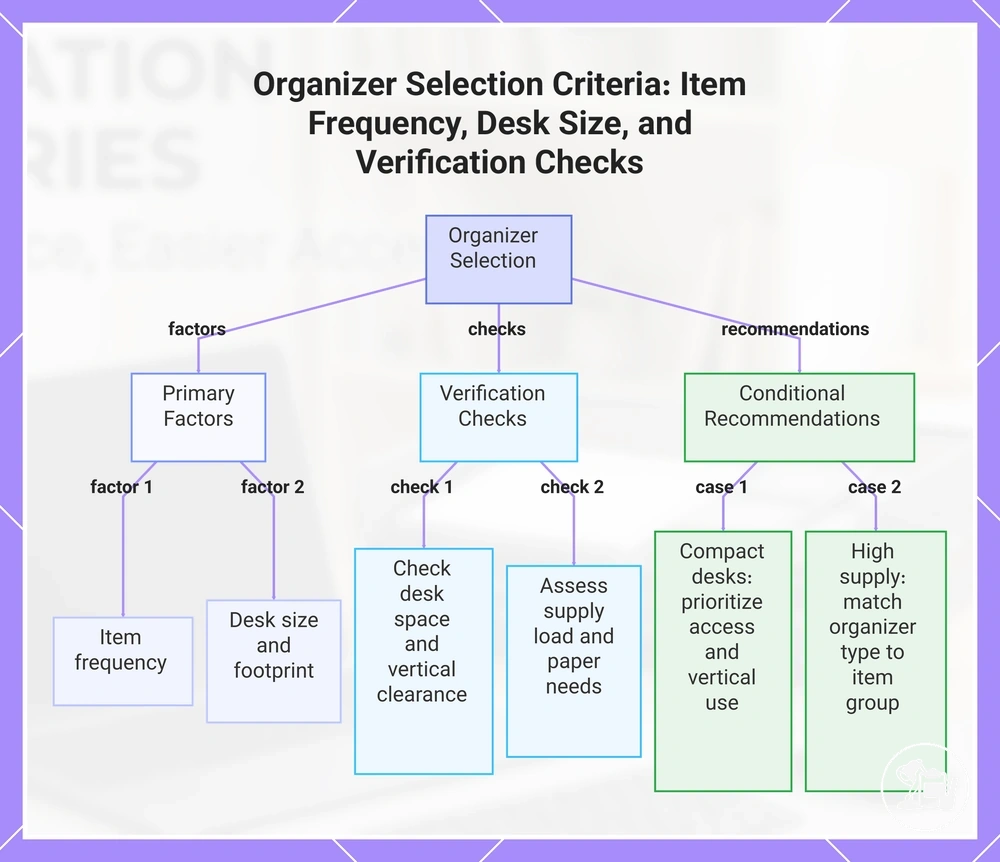
Choosing organizers depends on item frequency, desk size, footprint, and supply load. Organizer selection is most effective when frequently used items remain easy to access and occasional items occupy less prominent space. The relationship between item group, access frequency, desk size, and organizer footprint influences the decision outcome more than any single organizer type. Item frequency and desk size should lead selection.
- Verify how often the item group is used during daily study sessions.
- Check whether the organizer footprint fits the available desk area.
- Assess the overall supply load, including stationery and papers.
- Confirm whether drawer availability can reduce surface crowding.
- Evaluate vertical clearance before choosing a taller organizer.
- Determine whether paper load requires visible access or separated placement.
When compact desks have limited surface area, organizer selection may prioritize access while preserving usable workspace. A space-saving organizer may be suitable when daily-use items need quick reach but footprint must remain controlled. Vertical placement can help use available height if clearance remains adequate. These conditions are often relevant for compact desks.
When a high supply load makes materials harder to organize, matching organizer type to item group can improve sorting and access. Papers may require different placement considerations than writing tools because visibility and separation needs can vary. The decision outcome often improves when organizer type reflects both item frequency and supply volume. This consideration becomes more relevant with heavy stationery or paper supplies.
Choosing organizers works best when selection criteria are verified before placement rather than after clutter develops. Organizer selection should match item frequency, desk size, footprint, and supply load as a combined decision framework. The same criteria can support organization for small spaces when available desk area is limited.
This chart shows the primary factors and verification checks for selecting a desk organizer, along with conditional recommendations for compact desks and high supply loads.
Daily-use supplies kept within reach
Daily-use supplies should be positioned for easy reach to maintain workflow and support frequent access. High-frequency items benefit from placement in open organizers within the visible zone, allowing quick retrieval and minimizing unnecessary movement.
- Writing tools: Keep in a pen cup near the dominant hand to reduce reach and maintain workflow effect.
- Notepads and sticky notes: Place in an open tray close to the primary workspace for immediate access and frequent reference.
- Frequently used stationery: Arrange small items like scissors, rulers, or erasers in visible compartments to support workflow.
- Active worksheets or documents: Stack in a shallow tray within the visible zone to maintain access frequency.
- Other near-hand items: Use small open containers for items needed several times daily to limit movement and maintain efficiency.
On compact desks, avoid overcrowding the visible zone; overfilling open organizers can hinder reach and reduce workflow efficiency, so spacing should be verified before placing multiple daily-use supplies together .
Occasional supplies moved into drawers or vertical holders
Occasional supplies do not require prime reach and can be moved off the main surface while remaining easy to locate. Drawers and vertical holders support off-surface storage by separating less-used items according to access frequency, visibility needs, and desk-space effect. Lower use frequency is a practical reason for off-surface placement.
- Secondary stationery: Move into drawers when use is infrequent and main-surface space is needed for higher-frequency items.
- Occasional papers: Store in vertical holders when visibility supports easier location and paper access.
- Less-used study supplies: Separate from frequently used items to reduce crowding on the main surface.
- Drawer-stored items: Group by purpose or use pattern to support findability when supplies are needed again.
When occasional supplies are used periodically rather than daily, drawers may suit items with lower visibility requirements, while vertical holders may qualify when easier visual location is preferred. Off-surface placement should preserve findability so supplies remain easy to locate when needed.
Compact desks that need space-saving organizers
Compact desks have limited surface area, so organizer compatibility depends on desk width, desk depth, vertical clearance, footprint, and access needs. Space-saving organizers may remain usable when organizer size matches the available surface space and does not restrict reach. For compact desks, footprint is the primary compatibility cue.
- Footprint: Verify that organizer size fits the available desk width so working space remains usable.
- Desk depth: Check that the organizer does not limit access to frequently used items positioned behind it.
- Vertical clearance: Confirm that shelf height or stacked components fit within available overhead space.
- Reach: Ensure organizer placement supports access needs without forcing items beyond comfortable reach.
- Organizer size: Match compact organizers to the available surface area to improve suitability on narrow study tables.
When a compact desk has limited width or depth, space-saving organizers with a smaller footprint may qualify more easily because they preserve access and usable surface space. Vertical organizers may also remain suitable when vertical clearance supports reach and visibility. If arrangement details become more important than organizer compatibility, see arrange accessories cleanly.
Clean desk zones for organizers, stationery, and papers
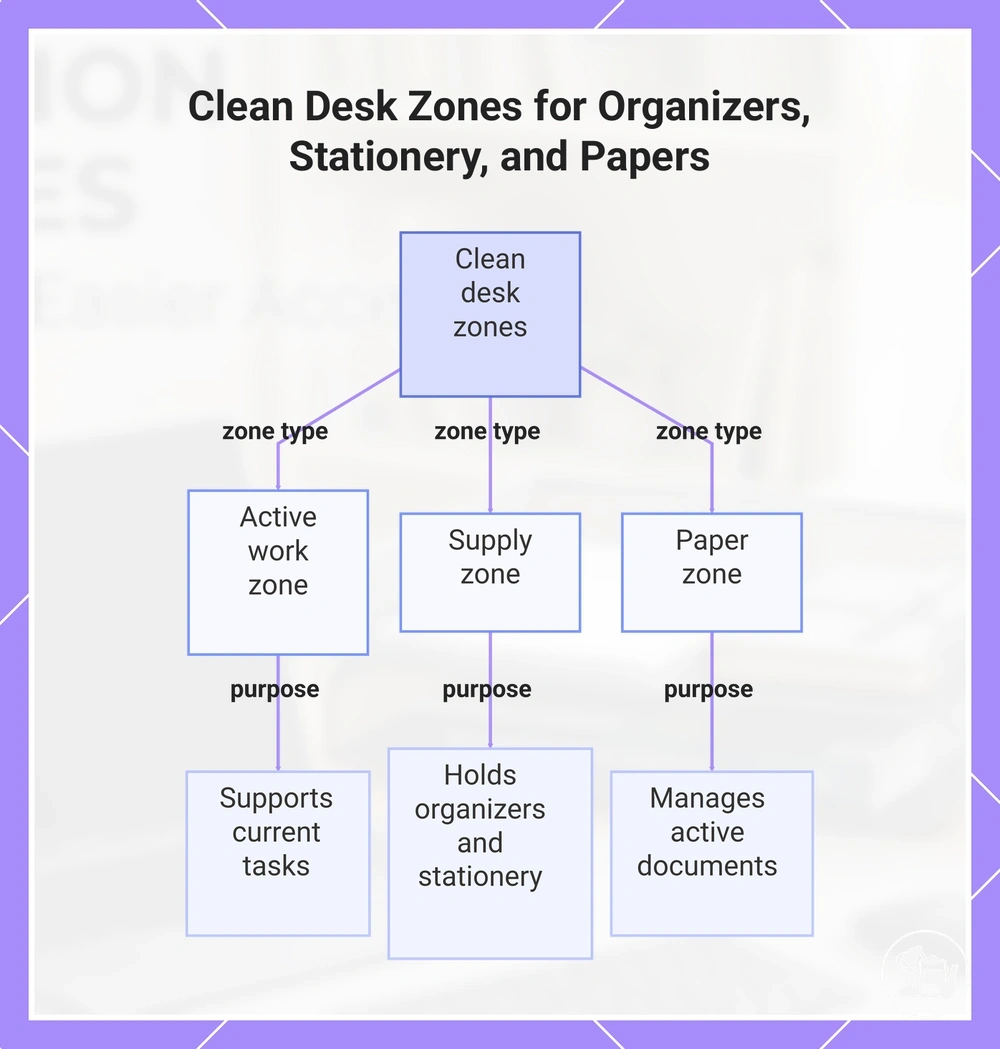
Clean desk zones separate organizers, stationery, and papers to prevent competition for surface space. A zone type designates a placement area for a specific item group, organizing materials according to access frequency and workflow effect. Clean desk zones focus on placement rather than providing a full setup workflow, ensuring frequently used items remain reachable without overlap.
When active work items, stationery, and papers occupy the same surface, access and visibility can be limited. An active work zone supports current tasks, a supply zone holds organizers and stationery, and a paper zone manages active documents. Defining these zones helps maintain clarity and separates stationery from paper zones, allowing each group to be reached efficiently.
Surface space pressure can reduce workflow efficiency when items compete for the same area. By placing organizers in a supply zone and papers in a dedicated paper zone, access frequency is maintained and active tasks remain unobstructed. Each zone’s placement supports workflow by keeping items within reach based on how frequently they are used.
Clean desk zones organize placement by item group, ensuring stationery and papers are separated while preserving active workspace. For further guidance on how to arrange these areas, see arrange accessories cleanly.
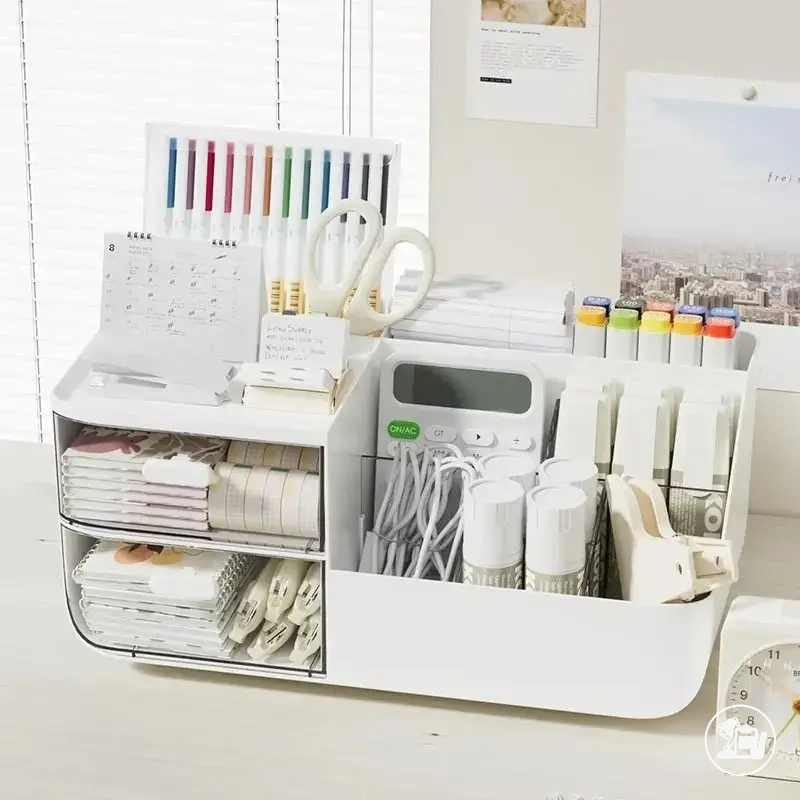
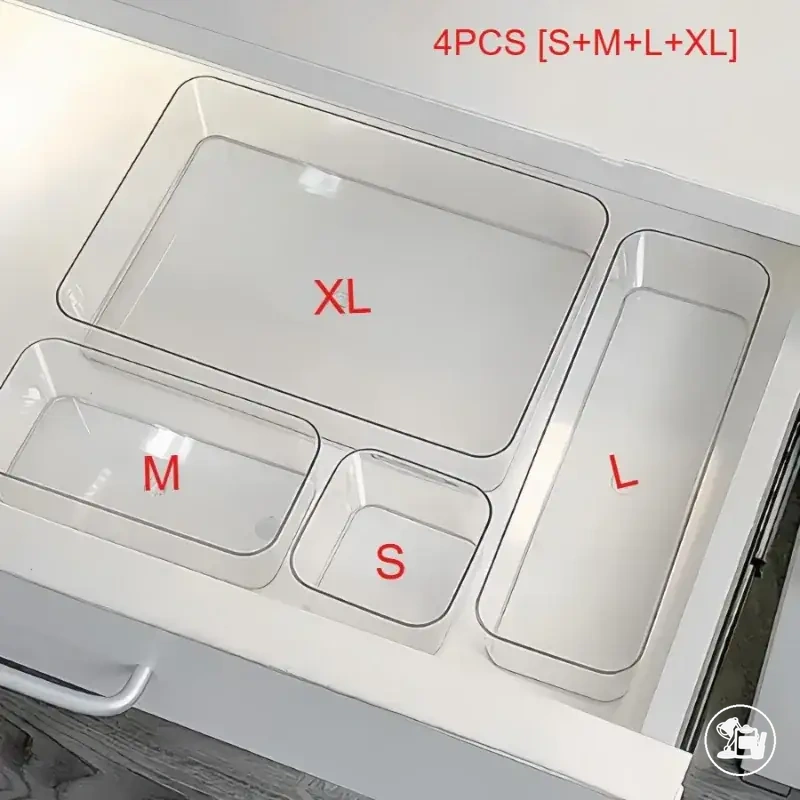
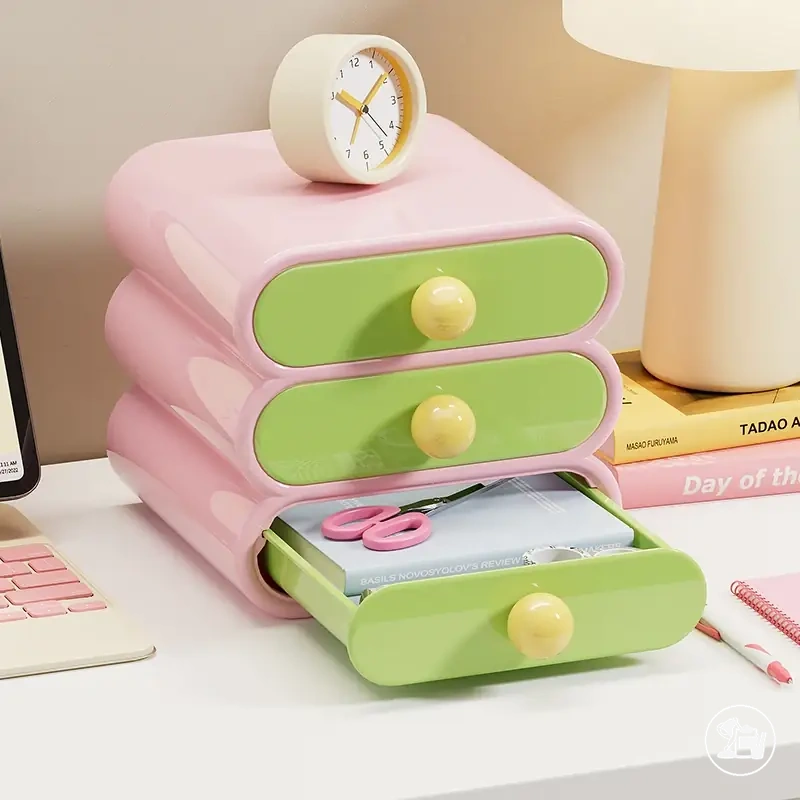
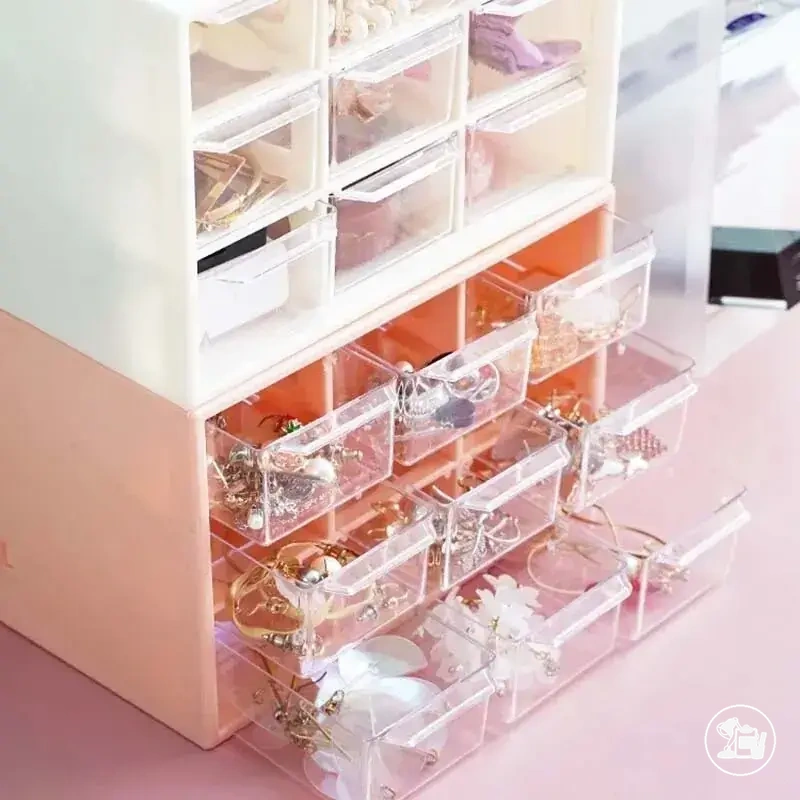
Here are product examples that may make comparison easier. Before buying, always review the compatibility criteria, essential features, and product details.

This chart shows the three types of clean desk zones and their specific functions to prevent surface space competition.
Common mistakes that make desk organizers create more clutter
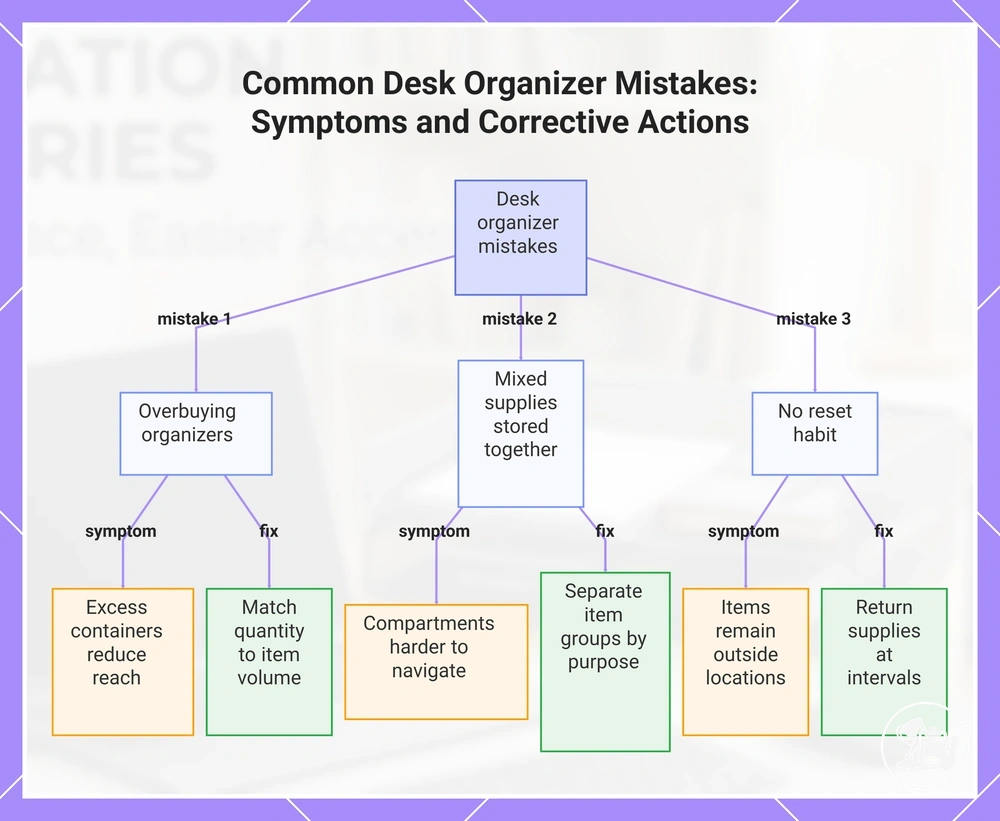
When desk organizers create more clutter, the cause is often a mismatch between organizer fit, item volume, and maintenance habits. A mistake may place more containers on the desk than the available space can support, making supplies harder to access. The resulting symptom is increased surface clutter rather than improved organization. These organizer mistakes are usually fit and habit problems rather than product problems.
Common mistakes that make desk organizers create more clutter can be diagnosed by linking each mistake to its visible symptom and a possible corrective action. The mini-checklist below focuses on causes related to fit, item volume, and maintenance rather than product replacement.
- Mistake: Overbuying organizers | Symptom: Excess containers occupy surface space and reduce reach | Corrective action: Match organizer quantity to actual item volume.
- Mistake: Mixed supplies stored together | Symptom: Compartments become harder to navigate and confusion increases | Corrective action: Separate unrelated item groups by purpose.
- Mistake: No reset habit | Symptom: Items gradually remain outside assigned locations | Corrective action: Return supplies to organizer zones at regular intervals.
A common scenario occurs when additional organizers are added each time supplies increase. The cause may be overbuying rather than a lack of storage, especially when empty or lightly used organizers consume surface space. The symptom is a desk that appears more crowded despite having more organizers. In this case, overbuying organizers is itself a symptom of a fit mismatch.
A common belief is that more compartments automatically improve organization. The truth is that mixed supplies placed across unrelated compartments can create confusion because item categories become less distinct. This desk organization error may make retrieval slower even when storage capacity remains available. The visible result is often mixed-supply confusion.
A reset habit is a practical corrective action when clutter gradually returns after study sessions. When supplies remain outside their intended locations, the symptom can worsen over time even if organizers are available. For ongoing upkeep, see cleaning and maintenance.
Here are product examples that may make comparison easier. Before buying, always review the compatibility criteria, essential features, and product details.
This chart shows three common desk organizer mistakes that create clutter, along with their visible symptoms and corrective actions.