
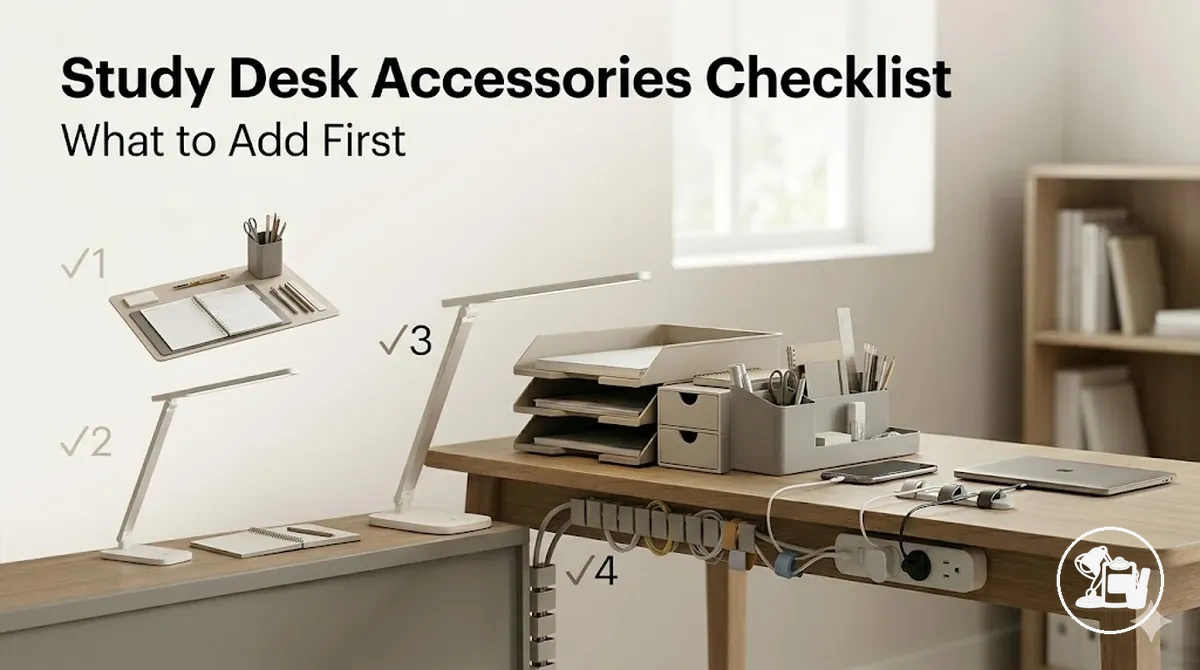
Study Desk Accessories Checklist: What to Add First
Study desk accessories checklist helps prioritize accessories that address the most common desk-use challenges before decorative or optional additions. This page uses a priority-based selection approach so study desk accessories can be evaluated by function rather than by appearance or quantity.
The checklist covers organization, lighting, cable management, ergonomic accessories, desk mat support, budget considerations, and fit checks. These categories help frame what to add first based on practical desk needs and study habits. Essential desk accessories support core desk functions, while useful or optional additions may be considered later depending on individual requirements. This distinction helps separate functional accessories from decorative additions.
The checklist is most useful when applied before comparing prices or considering extra setup accessories. Priority decisions may vary depending on available desk space, existing equipment, study routines, and comfort preferences. Reviewing function, fit, quality, and value first can make accessory selection more focused and easier to evaluate. The next section builds on this foundation by establishing the criteria used to identify priority accessories.
Not every accessory needs to be added at the same time. A gradual approach can help ensure that each addition addresses a specific need before moving to lower-priority items.
Grounding: Understanding Essential Desk Accessories
Essential study desk accessories are items that improve study desk function, access, lighting, comfort, or clutter control. They define the baseline tools that keep a workspace organized and functional, distinguishing them from decorative or non-critical additions. The main function categories include organization, lighting, cable management, surface support, and ergonomic comfort.
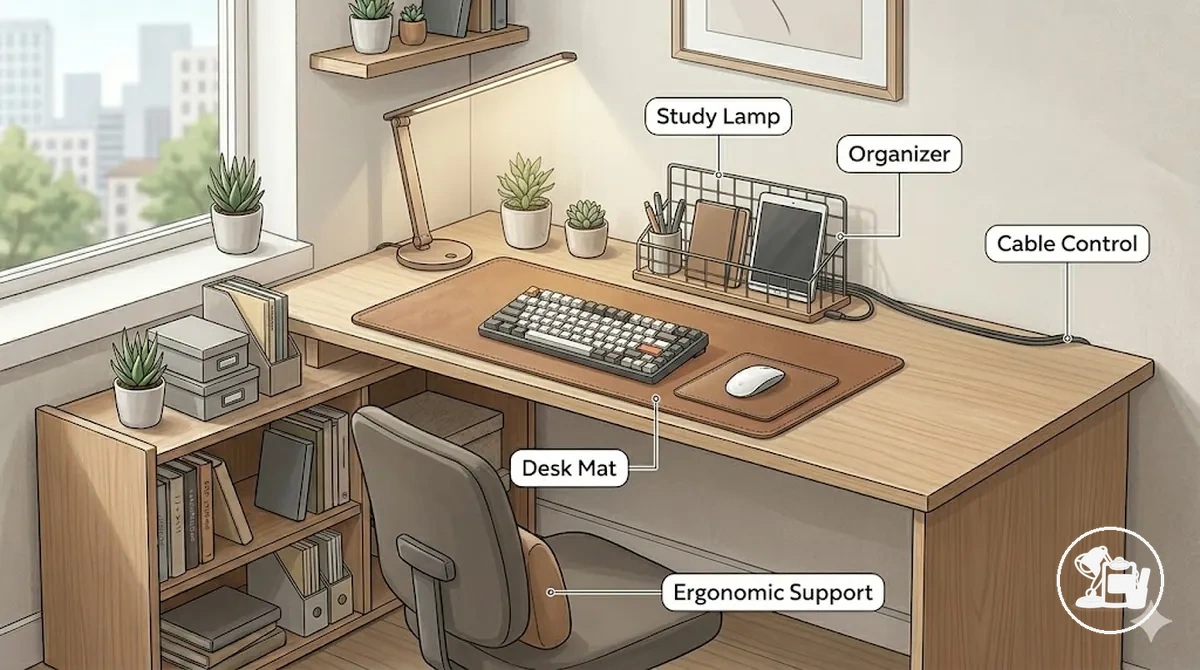
Essential accessories are typically those that directly support daily study activities, while optional accessories depend on specific desk conditions, personal habits, or available space. Decorative items or items that duplicate function are considered optional and can be deferred until core needs are met. This boundary helps maintain clarity in checklist use and setup decisions.
For example, an organizer enhances access and reduces clutter, a study lamp provides adequate lighting, cable control keeps wires manageable, a desk mat protects and supports the work surface, and ergonomic support promotes comfort under frequent use. For a more detailed breakdown of function categories, refer to essential accessory categories:contentReference[oaicite:0]{index=0}.
Desk Organization and Storage Solutions
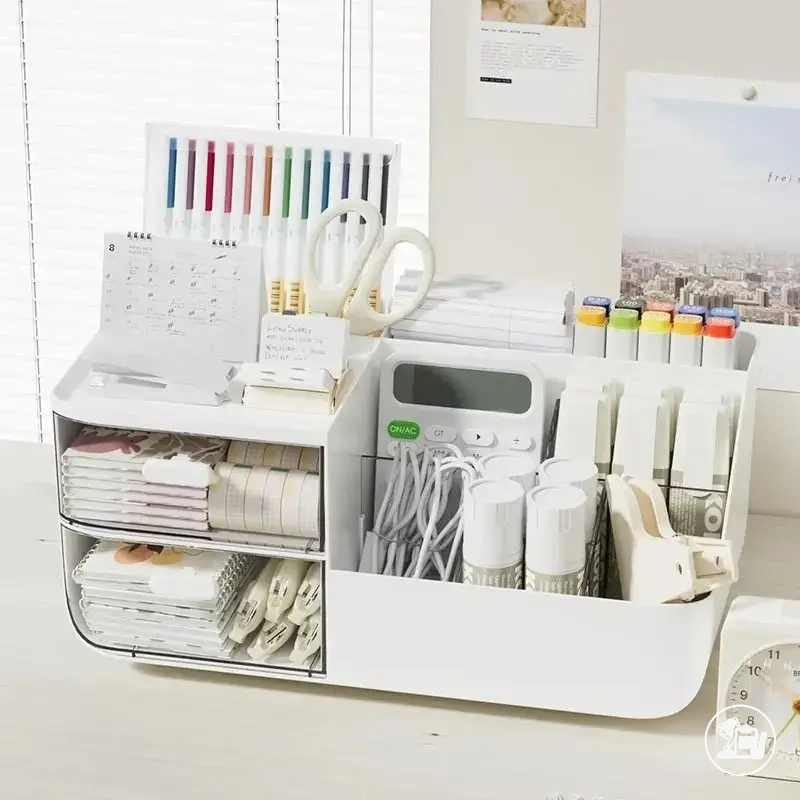
Desk organization and storage solutions help keep study materials visible, reachable, and separated according to how often they are used. When notebooks, stationery, and reference items compete for limited desk space, organization and storage accessories can improve access and make retrieval easier. Their primary role is to support access and clutter control.
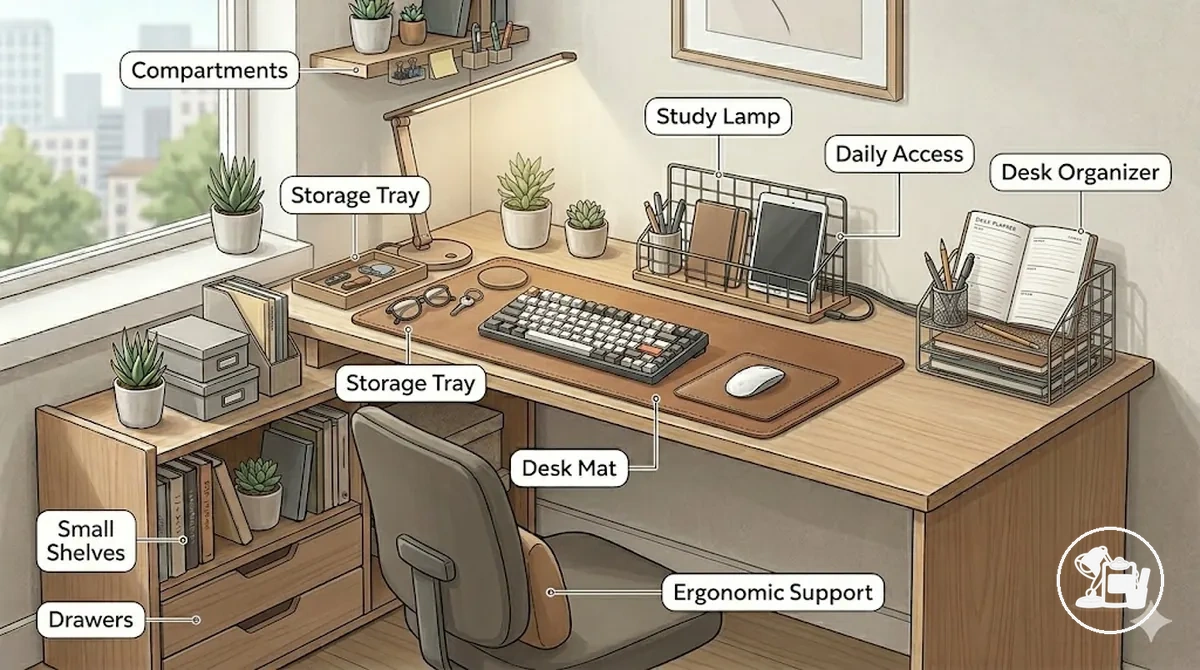
A desk organizer, tray, compartments, drawers, and similar storage solutions change how materials are grouped and accessed. The most suitable option often depends on material volume, desk size, and daily-use frequency. Desk Organization and Storage Solutions can be assessed through access, capacity, and clutter-control functions as shown below.
- A desk organizer with compartments increases access to frequently used stationery, making daily-use items easier to reach and prioritize.
- A storage tray groups related materials in one place, improving retrieval when loose items begin to occupy desk space.
- Compartments separate supplies by purpose, helping maintain visibility when multiple study tools are used throughout the day.
- Drawers provide additional capacity for less frequently used materials, making them more suitable for extra storage than constant access.
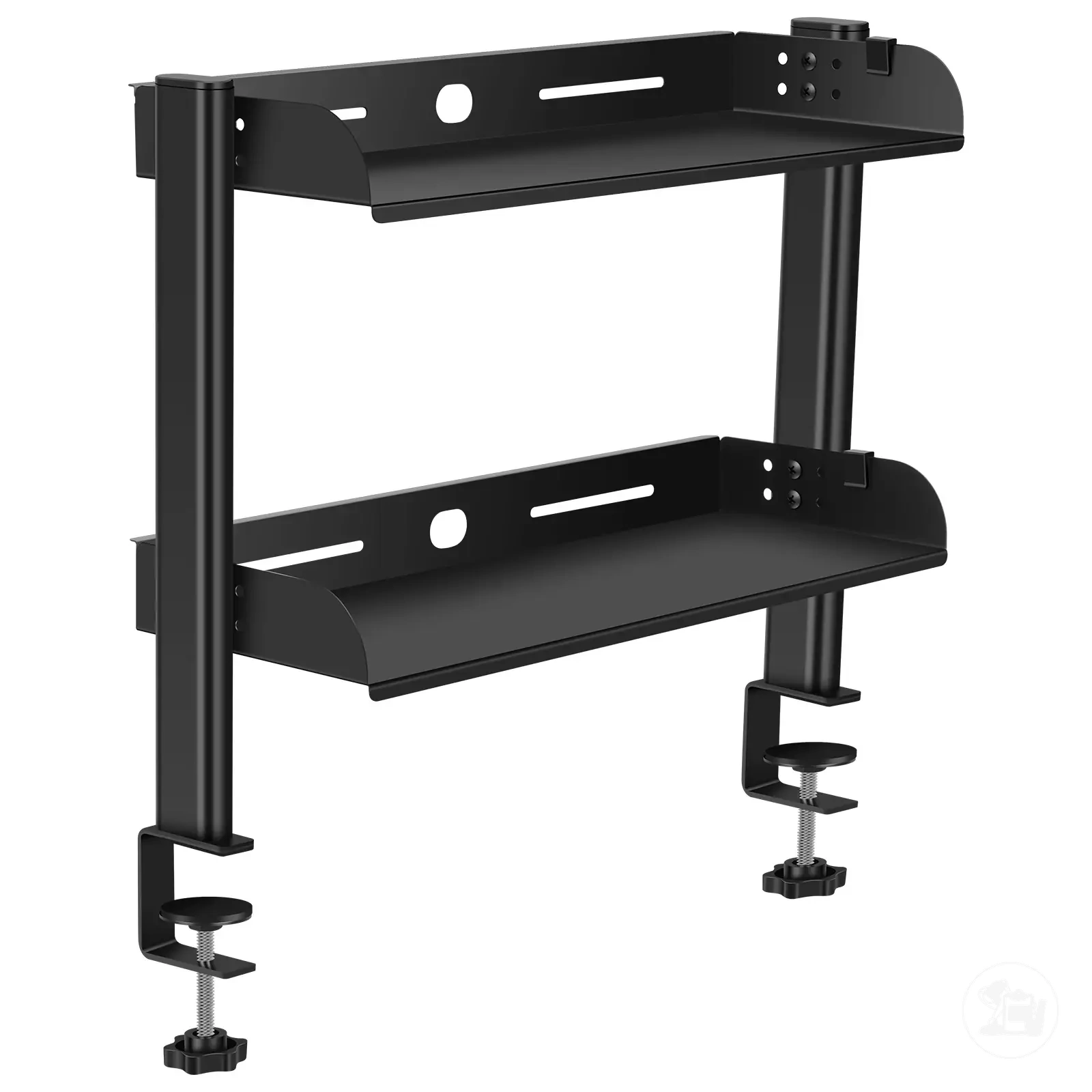
- Small shelves expand vertical storage space and may help separate reference materials from daily-use study items when desk space is limited.
Daily-use organizers focus on immediate access, while extra storage is intended for materials that do not need constant visibility. A study table organizer may improve separation and retrieval, but outcomes depend on the amount of material being managed and how the desk is used. For broader setup context beyond local organization decisions, see the study desk setup accessories guide.
Study Desk Lighting Essentials
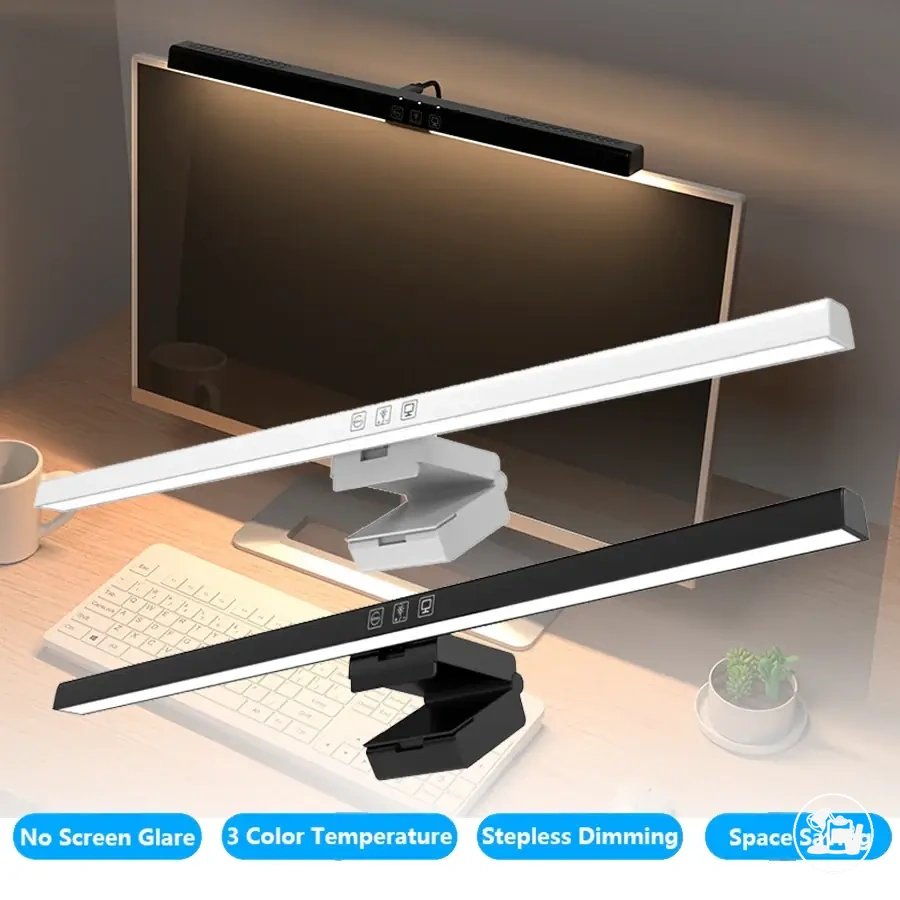
Study desk lighting helps make reading, writing, and screen-side study easier by directing light where study tasks take place. A desk lamp supports task lighting under different room conditions, helping maintain visibility for reading, writing, and screen-side study.
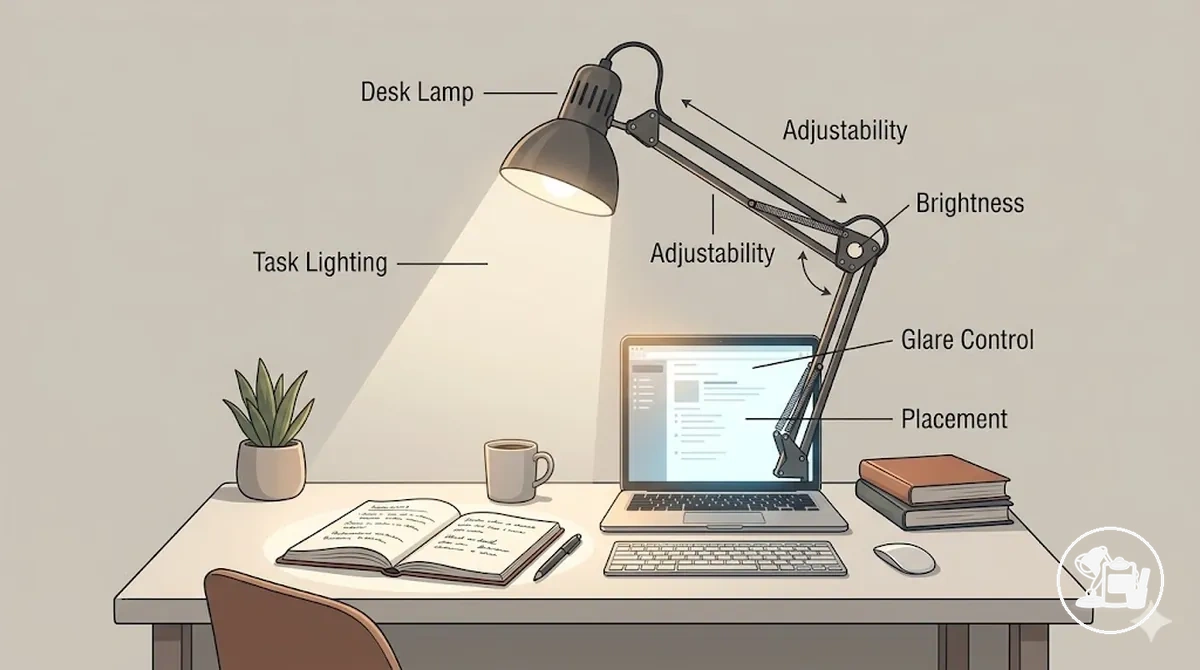
Study desk lighting depends on task type, adjustability, brightness control, and placement. A desk lamp may need different positioning depending on whether the primary activity involves a book, notebook, or screen. The following Study Desk Lighting Essentials are organized by task fit, adjustability, brightness, and placement.
- Lamp Type: An adjustable desk lamp directs task lighting toward specific reading or writing areas, making it easier to match light to the study task.
- Adjustability: Greater adjustability can help change light direction when desk position or study materials vary throughout the day.
- Brightness Control: Adjustable brightness allows lighting to be adapted to different room conditions and study activities.
- Glare Control: Light direction and lamp positioning can help reduce glare on a screen or reflective surface when conditions create visual distractions.
- Placement: Proper placement helps keep the active study area illuminated while reducing unwanted shadows on books, notebooks, or a screen.
When a desk is dim or the writing area is frequently shadowed, a basic adjustable lamp may deserve higher priority than less essential accessories. Lighting can support visual comfort, but outcomes depend on room conditions, glare sources, task type, and desk layout.
Cable Management and Wire Control
Cable management and wire control refers to accessories that reduce visible clutter and make charging or device use easier around a study desk. Proper wire organization helps maintain a tidy workspace while keeping charging cables and connected devices accessible.
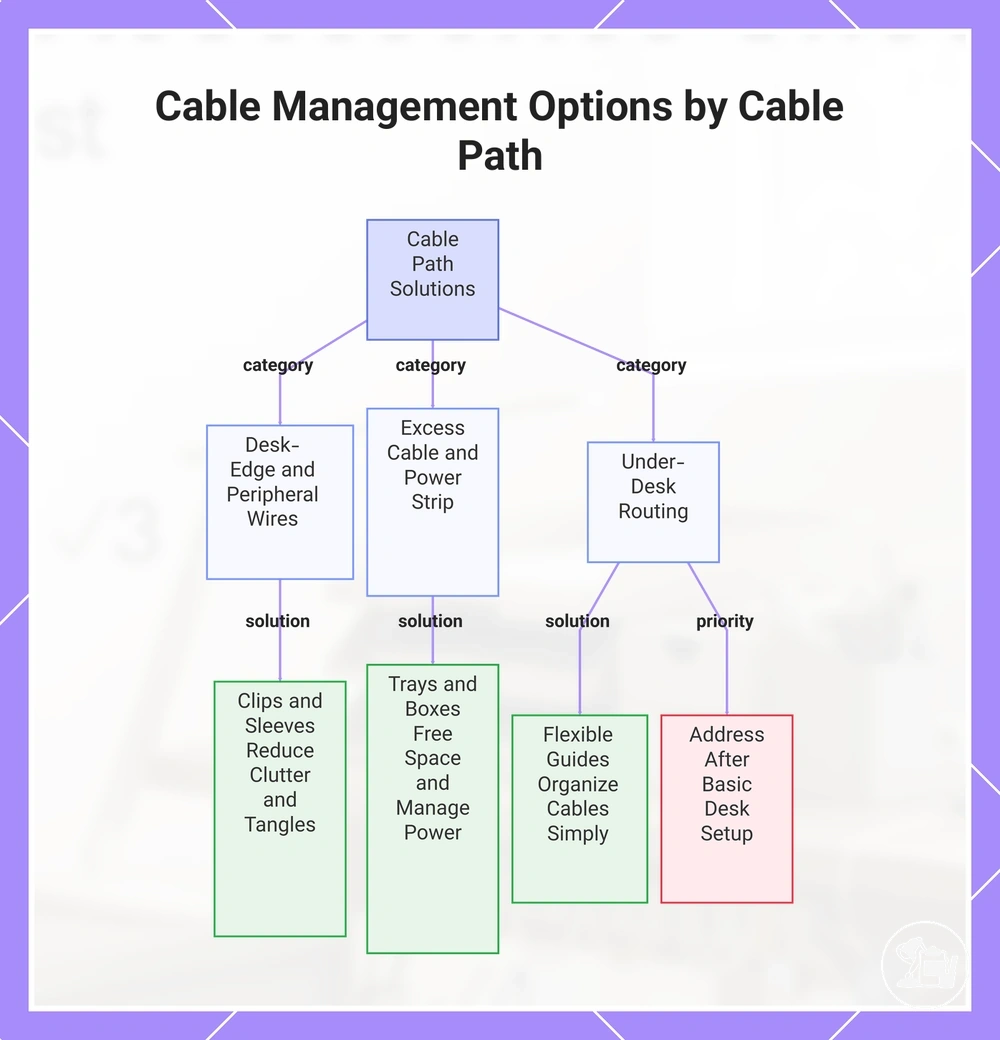
Wire-control options differ by cable path, attachment method, and desk layout. Tools such as clips, sleeves, trays, and boxes can guide cords and improve usability. The following list outlines how specific cable paths and accessories affect access and clutter control.
- Desk-edge charging cables → Cable clips → Keep cords reachable and reduce surface clutter.
- Grouped peripheral wires → Cable sleeve → Bundle multiple cables to prevent tangling and improve visual order.
- Excess cable length → Cable tray → Route cords along or under the desk to free workspace while maintaining access.
- Power strip connections → Cable box → Contain plugs and adapters to limit visible mess and allow easier power management.
- Under-desk routing → Flexible guides → Separate multiple cables while keeping them organized and accessible without complex installation.
More complex under-desk routing should be addressed only after basic desk functionality is established, as most visible clutter can be controlled with surface-level wire organization using clips, sleeves, trays, and boxes:contentReference[oaicite:0]{index=0}.
This chart categorizes cable management accessories by cable path type, listing recommended solutions for desk-edge wires, excess cables, power strips, and under-desk routing, with a note on priority for under-desk setup.
Ergonomic Accessories for Comfort and Posture
When a study desk setup forces awkward screen, wrist, book, or seating positions, ergonomic accessories can help adjust how study materials and devices are used. These accessories are most useful when a desk position creates a recurring setup challenge rather than a temporary inconvenience. Their relevance often depends on the specific posture problem and study duration.
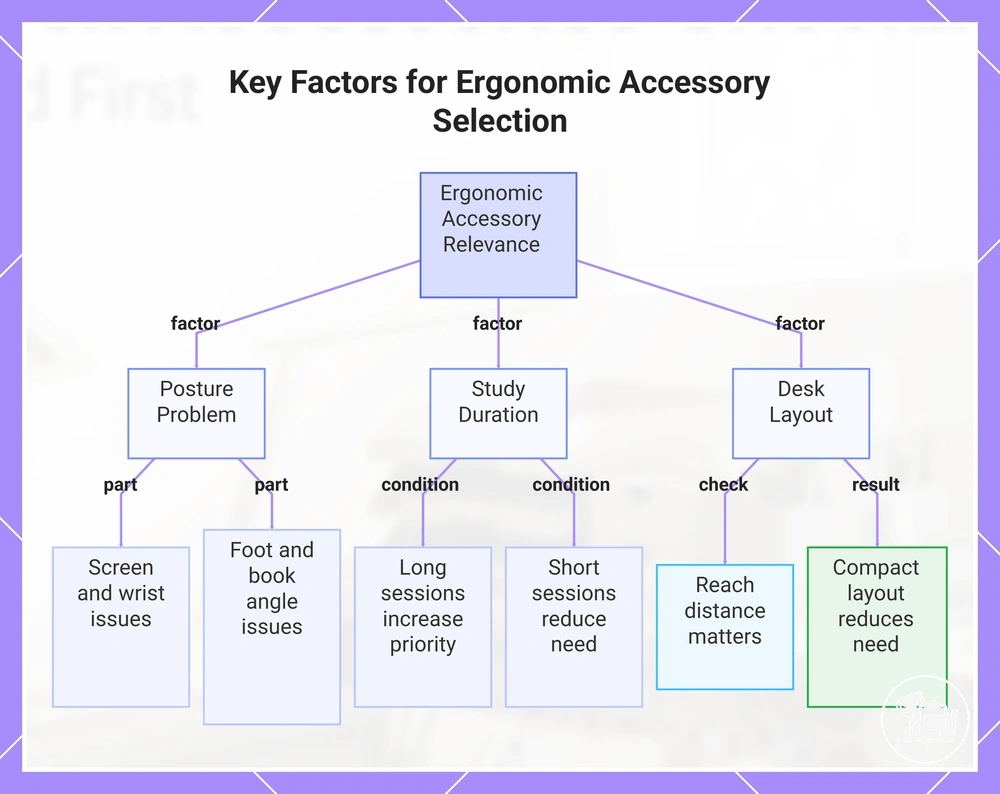
Ergonomic accessories should be evaluated according to the posture issue they address and the amount of time spent studying. Short sessions may require fewer adjustments, while longer sessions can make screen height, wrist position, book angle, or reach distance more noticeable. The following examples show when certain ergonomic accessories may become a higher or lower priority.
- Monitor Stand → Screen Height → May become important when the screen position is noticeably above or below a comfortable viewing level, but can be optional when screen height already suits the desk setup.
- Wrist Support → Writing or Typing Position → May help when extended writing or typing creates an awkward wrist position, while shorter sessions may require less support.
- Foot Support → Seating Condition → May become more relevant when desk and seating height create an unsupported foot position during study sessions.
- Book Stand → Reading Angle → May deserve higher priority when reading materials remain open for extended periods and the book angle is difficult to maintain comfortably.
- Reach Distance Adjustment → Desk Layout → May become important when frequently used items are positioned too far from the primary study area, while a compact layout can reduce the need for additional support items.
Ergonomic accessories can support comfort and posture by matching specific desk-position challenges, but their usefulness depends on screen height, wrist position, foot placement, book angle, reach distance, and study duration rather than universal necessity【133†source】.
This chart shows the main factors that determine the relevance of ergonomic accessories for study desk comfort and posture.
Desk Mat and Surface Considerations
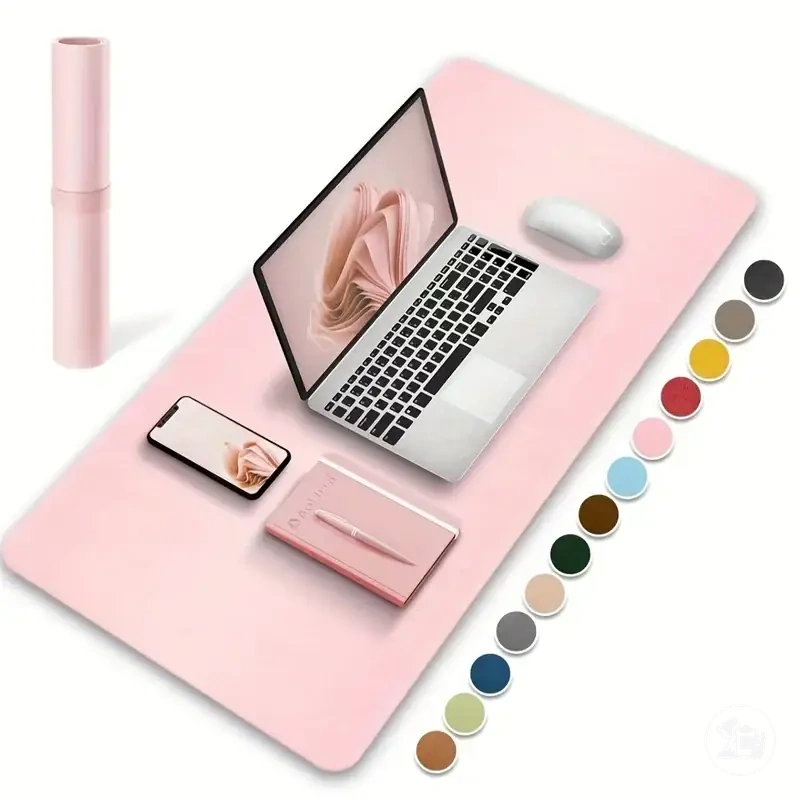
A desk mat affects writing feel, mouse movement, surface protection, and workspace zoning by creating a dedicated working area on the desk surface. Whether a desk mat is useful depends on the existing surface condition and the type of study activities being performed, making it a surface support decision rather than a universal requirement.
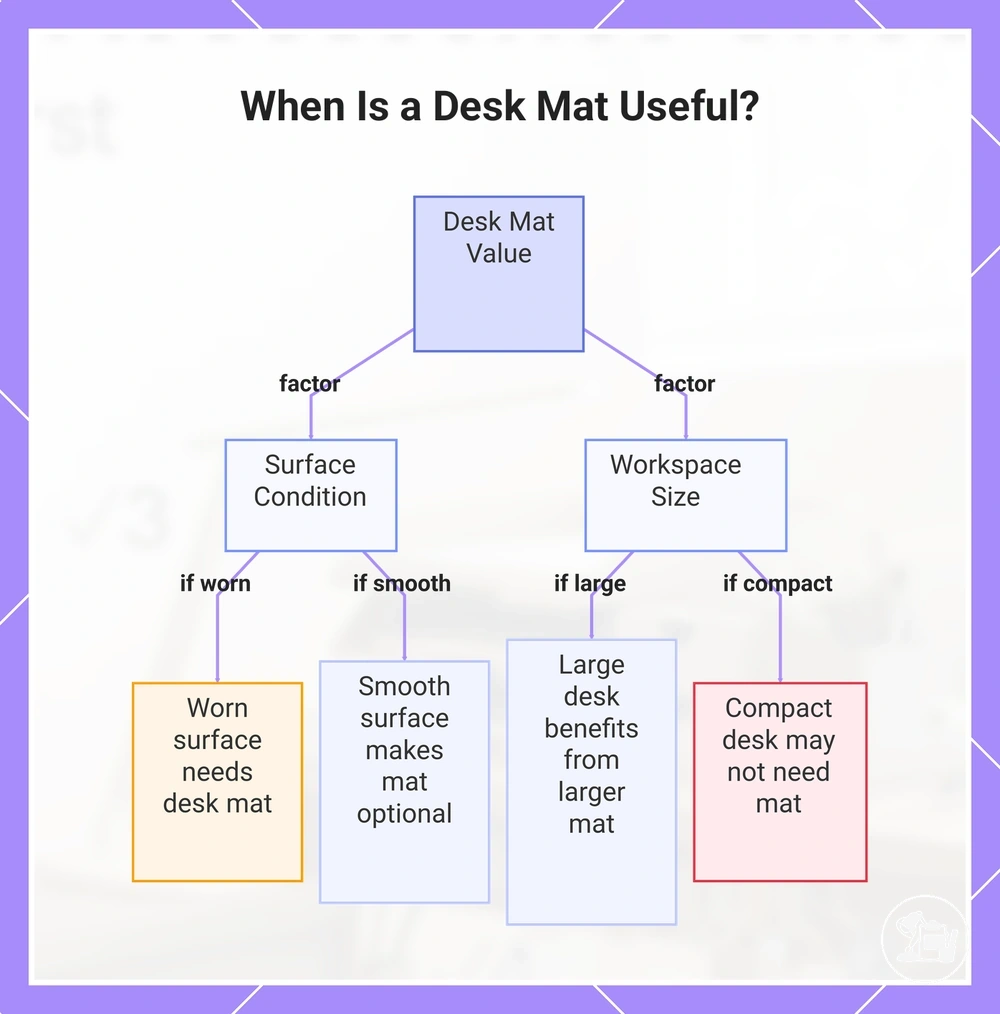
Material, size, grip, cleaning ease, and edge fit influence how a desk mat interacts with the desk surface. Writing feel and mouse movement may vary depending on the material and surface condition, while surface protection and workspace zoning remain direct physical functions. Surface choices can clarify organization and define working areas, as shown in the comparison below.
- Worn, scratched, or slippery surface → Desk mat is useful because it adds surface protection and may improve writing feel and grip.
- Smooth and stable surface with satisfactory mouse movement → Desk mat may be optional when the existing writing surface already performs well.
- Large desk with multiple study items → Larger mat size can help workspace zoning when edge fit aligns with the available surface area.
- Compact desk with limited free space → Desk mat may be optional if size and edge fit reduce usable workspace rather than support it.
Desk mat value depends on material, size, grip, cleaning ease, edge fit, and desk surface condition. A study table mat can support surface organization and protection when those conditions create a clear need, but it is not required for every desk setup【147†source】.
This chart shows the two main factors that determine whether a desk mat is useful: surface condition and workspace size.
Selection Criteria: What to Add First
The first accessory should address the most frequent or limiting study desk problem, ensuring that the initial addition resolves the condition that most often interrupts study tasks.
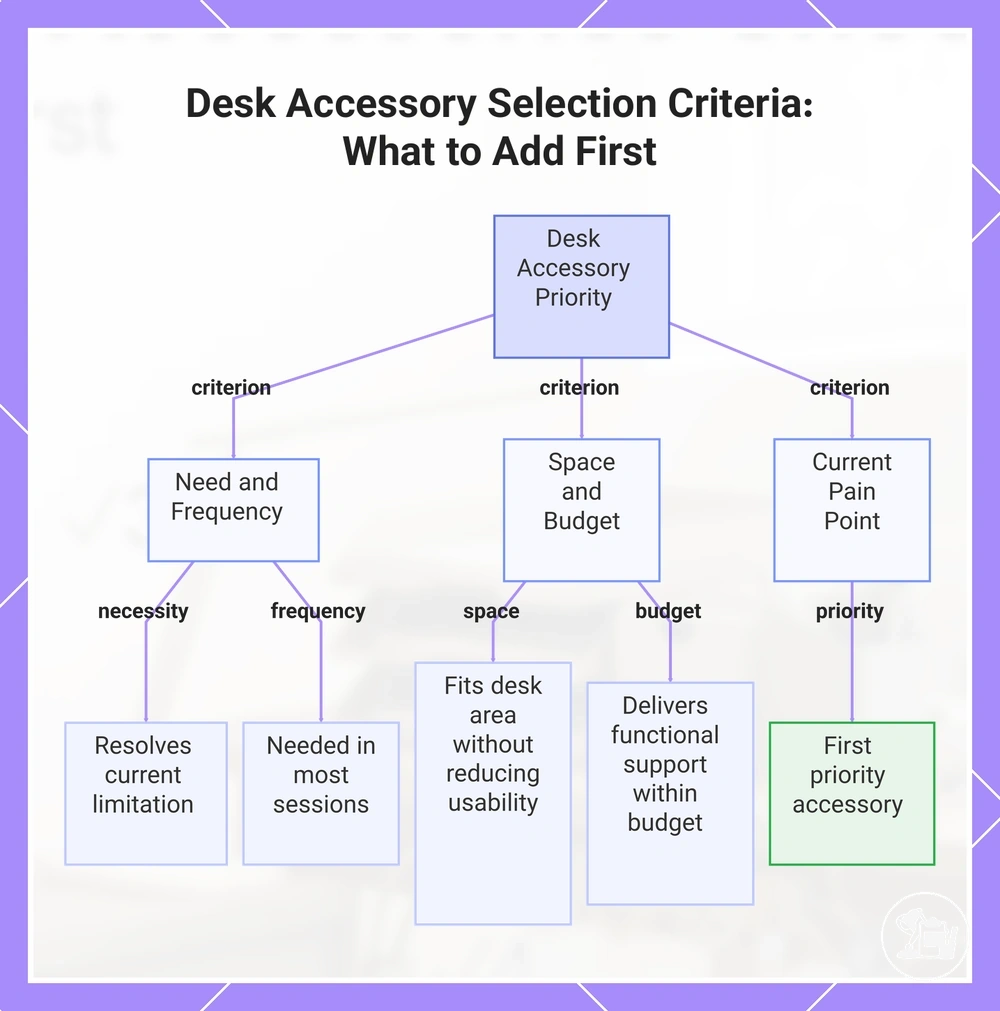
Selection criteria rank accessories by need, frequency of use, available space, and budget. Accessories that remove recurring limitations or frequent obstacles may be considered higher in priority. The following checklist organizes buying decisions using these criteria.
- Accessory category → Necessity → Resolves current limitation → High priority.
- Accessory category → Frequency of use → Needed in most study sessions → Higher priority than occasional-use items.
- Accessory category → Space → Fits available desk area without reducing usability → Higher decision value.
- Accessory category → Budget → Delivers functional support within current spending limits → Earlier consideration.
- Accessory category → Current pain point → Addresses the most disruptive desk problem → First priority.
For example, a cluttered desk may make an organizer the first addition, a dim desk may prioritize a lamp, and a cable-heavy desk may focus on cable management. An uncomfortable desk may elevate ergonomic accessories, while limited budget may focus on high-need items and delay less urgent accessories. After applying these selection criteria, it becomes easier to compare local decisions with what is worth prioritizing:contentReference[oaicite:0]{index=0}.
This chart shows the main criteria for prioritizing which study desk accessory to purchase first, based on need, frequency, space, budget, and current pain points.
Budget-Friendly Prioritization of Accessories
Budget changes the order in which study desk accessories should be added by making cost-value the main filter. The first purchase should solve a high-use or limiting desk problem while preserving budget priority.
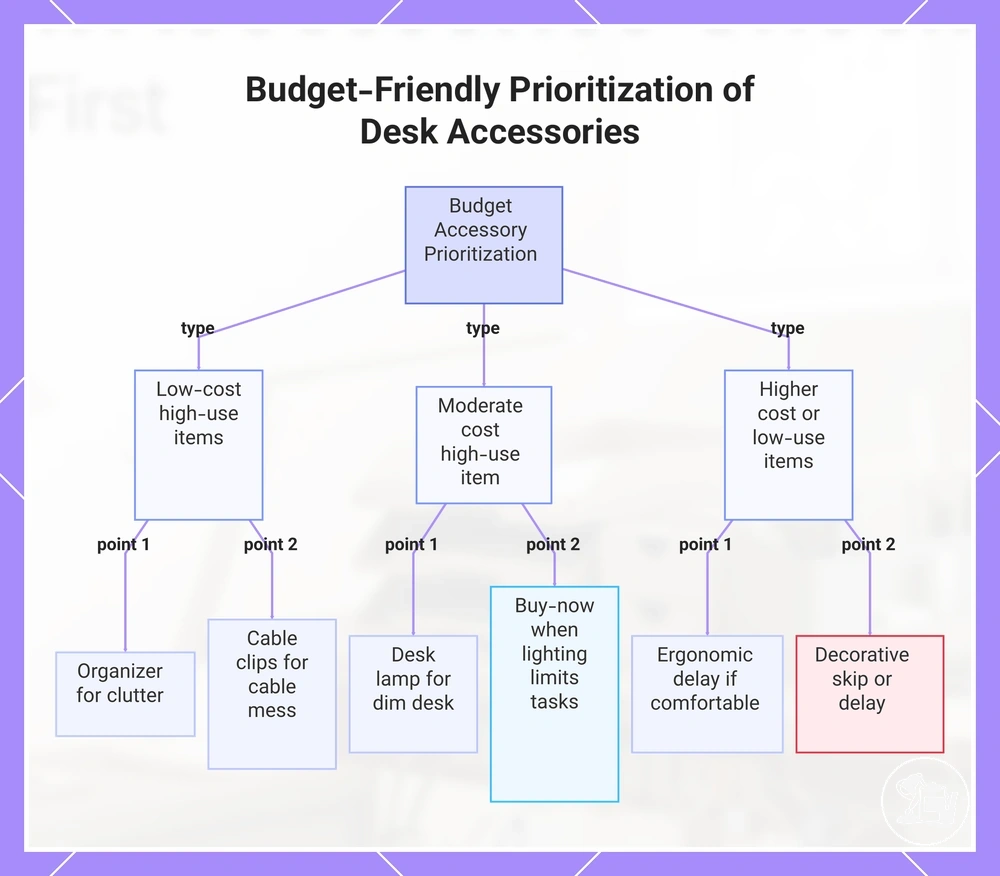
Cost-value trade-offs compare cost level, frequency of use, and functional need. A low-cost accessory may move earlier when it solves a recurring problem, while a higher-cost item may be delayable when the current setup already works. The budget-priority checklist below organizes low-cost, high-use, and delayable accessories.
A budget buying order helps connect accessory category, cost level, and value condition before choosing whether to buy-now, delay, or skip. This keeps affordable desk accessory decisions focused on use, not price alone.
- Organizer → Low-cost → High-use on a cluttered desk → Buy-now.
- Desk lamp → Moderate cost → High-use on a dim desk → Buy-now when lighting limits study tasks.
- Cable clips → Low-cost → Useful on a cable-heavy desk → Buy-now when charging access affects usability.
- Ergonomic accessories → Higher cost → Value depends on comfort need and study duration → Delay when the current setup is comfortable enough.
- Decorative or duplicate accessories → Any cost level → Low functional value for the current desk problem → Skip or delay.
For example, a simple organizer may be a better first purchase than a larger delayable accessory when the desk is cluttered and the budget is limited. If the desk is dim, the same budget may be better directed toward a lamp before lower-use additions.
An external price-check can support decision confidence, but it should not replace the cost-value logic of need, frequency, fit, and delayability. Cheaper options may still vary in durability, fit, and comfort, so the final choice should match the desk problem rather than price alone.
This chart shows how to prioritize study desk accessories using a cost-value filter, grouping them by cost level and use frequency to decide buy-now, delay, or skip.
The products below are useful examples for comparing available options. Before buying, check that the compatibility criteria, key features, and product details match your needs.

Fit, Quality, and Value Checks Before Purchase
Every accessory should be checked for desk fit, build quality, and real use value before purchase consideration. This verification step improves suitability and supports fit checks, quality checks, and value checks.
These checks help prevent mismatched, flimsy, or unnecessary accessories from becoming part of the study setup. An accessory that fits the desk but fails a quality review may create usability concerns, while a well-made accessory with poor fit may offer limited value. The verification checklist below helps identify pass and risk conditions before making a decision.
Using structured fit and quality checks creates a clearer connection between accessory attributes and purchase confidence. Deeper buying checks support verification by evaluating suitability before any external price-check is considered.
- Size → Check desk fit and available space → Pass when the accessory fits the intended area without limiting normal use; risk when placement creates interference.
- Stability → Check base support and movement during use → Pass when the accessory remains stable under expected conditions; risk when movement affects usability.
- Material → Check surface condition and construction quality → Pass when the material appears suitable for the intended environment; risk when suitability is uncertain.
- Adjustability → Check whether positions or angles match use conditions → Pass when adjustment supports expected tasks; risk when flexibility is limited.
- Cable compatibility → Check device connections and cable routing needs → Pass when cables can be managed appropriately; risk when compatibility depends on unsupported assumptions.
- Cleaning ease → Check maintenance requirements and surface accessibility → Pass when routine cleaning appears manageable; risk when upkeep may become difficult.
For example, an accessory may pass size and material checks but remain a risk if stability depends on a desk condition that has not been verified. When a pass or risk outcome depends on desk size, material, or device use, suitability checks should be completed before moving forward.
An external price-check can support final decision readiness after verification is complete. Purchase confidence should come from fit checks, quality checks, and value checks first, with price considered only after suitability has been reviewed.
The products below are useful examples for comparing available options. Before buying, check that the compatibility criteria, key features, and product details match your needs.